
A-MIM – complex metal parts without tooling
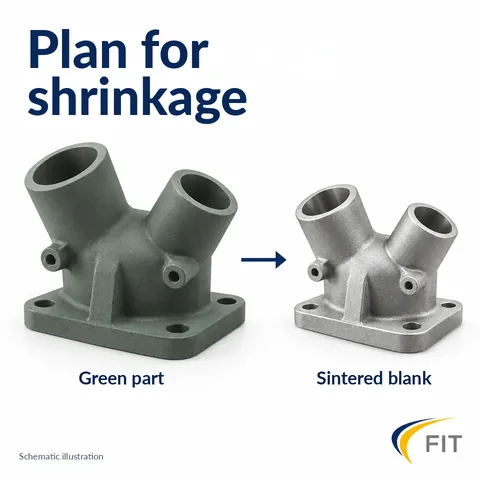
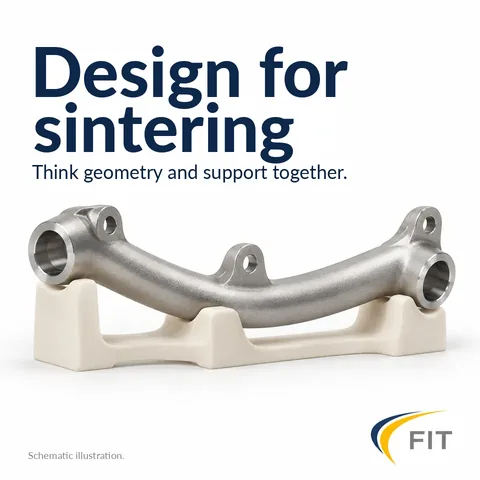
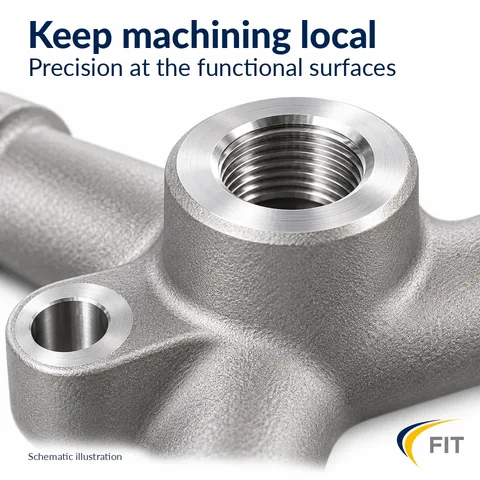
With A-MIM (additive MIM), the geometry is created by building up a green part layer by layer – a part made of metal powder that is initially held together by a binder. During the subsequent sintering, a heat treatment below the melting temperature, the metal particles bond: the material densifies into the metallic blank. Functional surfaces such as fits, threads or sealing seats are post-processed where required.
Which parts is A-MIM suited for?
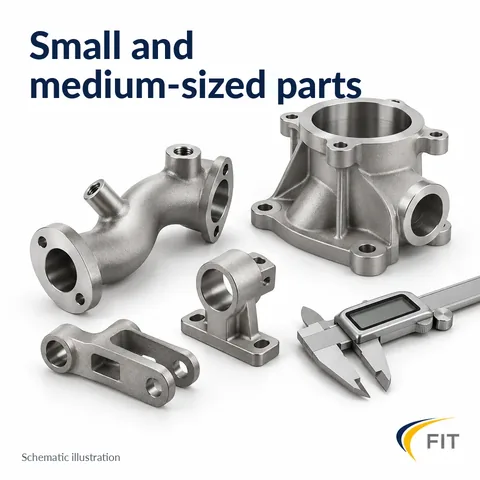
Typical are metal parts of roughly 10 × 10 × 10 mm up to 150 × 100 × 80 mm with up to about 60 cm³ of volume – in stainless steel, that is up to about 470 g – where at least one of the following applies:
- The shape is complex: internal channels, undercuts, ribs or pockets.
- The part is currently made of several pieces that are joined or assembled.
- A large share of the starting material is currently machined away.
- There are variants or a part family for which a separate mold for each version is not worthwhile.
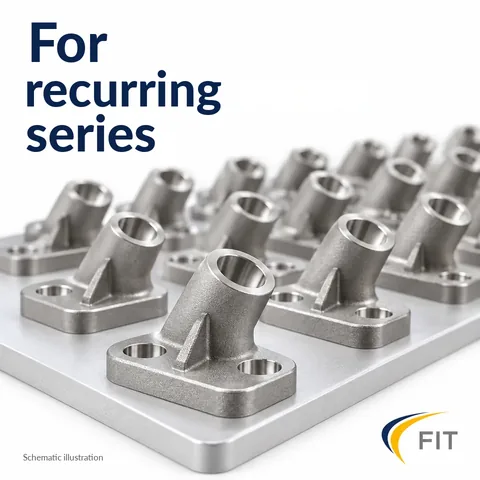
A-MIM usually becomes economically interesting from a few hundred parts per year. As a range to evaluate, we give 250 to 50,000 pieces per year across the whole part family. For single parts and small quantities of up to about 50 pieces, laser powder bed fusion is usually more economical.
All values are guidelines, not hard limits. Size is also affected by build space, weight during sintering and shrinkage – that is, the contraction during sintering, which is planned for from the start.
Where advantages can arise
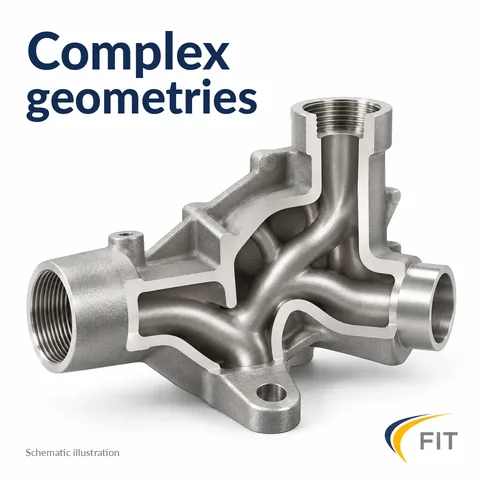
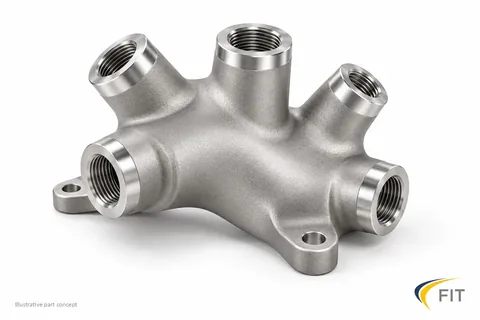
Complex geometries and internal channels
Channels, undercuts and ribs are produced without additional tooling. Complexity is still not free: the printing process, build-space utilization, handling, depowdering, sintering and post-processing determine the effort.
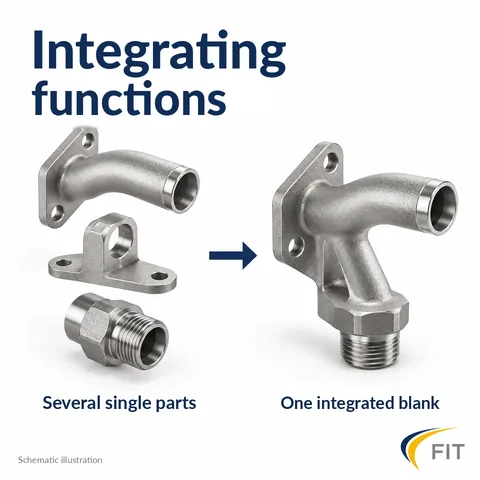
Consolidating functions and parts
Several parts of an assembly become one blank. Joints, assembly and the associated inspections can be eliminated – inspection of the finished part, for example for leak tightness, is not automatically eliminated as a result.
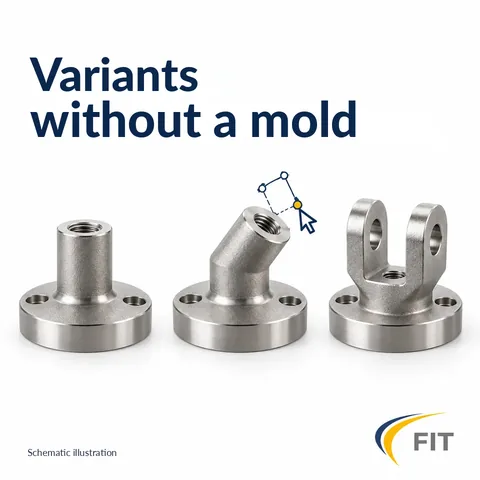
Variants without new tooling each time
A variant starts as a CAD change, not as new tooling. Depending on the change, manufacturing and sintering behavior have to be reassessed.
Less material removal, targeted post-processing
The blank is produced close to net shape. Machining is done where the function requires it – this saves material and often setups compared with machining from solid stock.
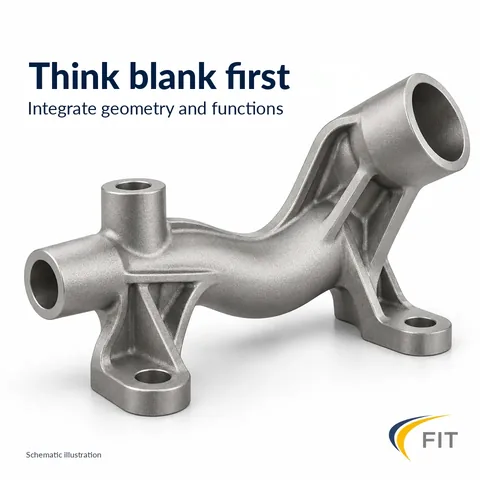
Three basic principles
Orientation: when it gets harder
Nothing is ruled out by this – what matters is comparing the entire manufacturing chain up to the ready-to-install part. A closer look is worthwhile for parts larger than about 150 × 100 × 80 mm or 60 cm³, for very small or filigree parts, for shapes that sag in the furnace, for tight tolerances almost everywhere, for simple turned and milled parts, below about 50 pieces and from about 50,000 identical parts per year. All limits with figures and rationale
Whether a part is fundamentally suitable, whether a design improvement makes it more economical, and what process design manufacturing needs are three separate questions. What this means