The strongest case for A-MIM: many marketable variants – with as little change as possible to the sintering-relevant base body.
All examples on this page are application concepts for stainless steel, not FIT customer references.
The principle: variant family instead of single part
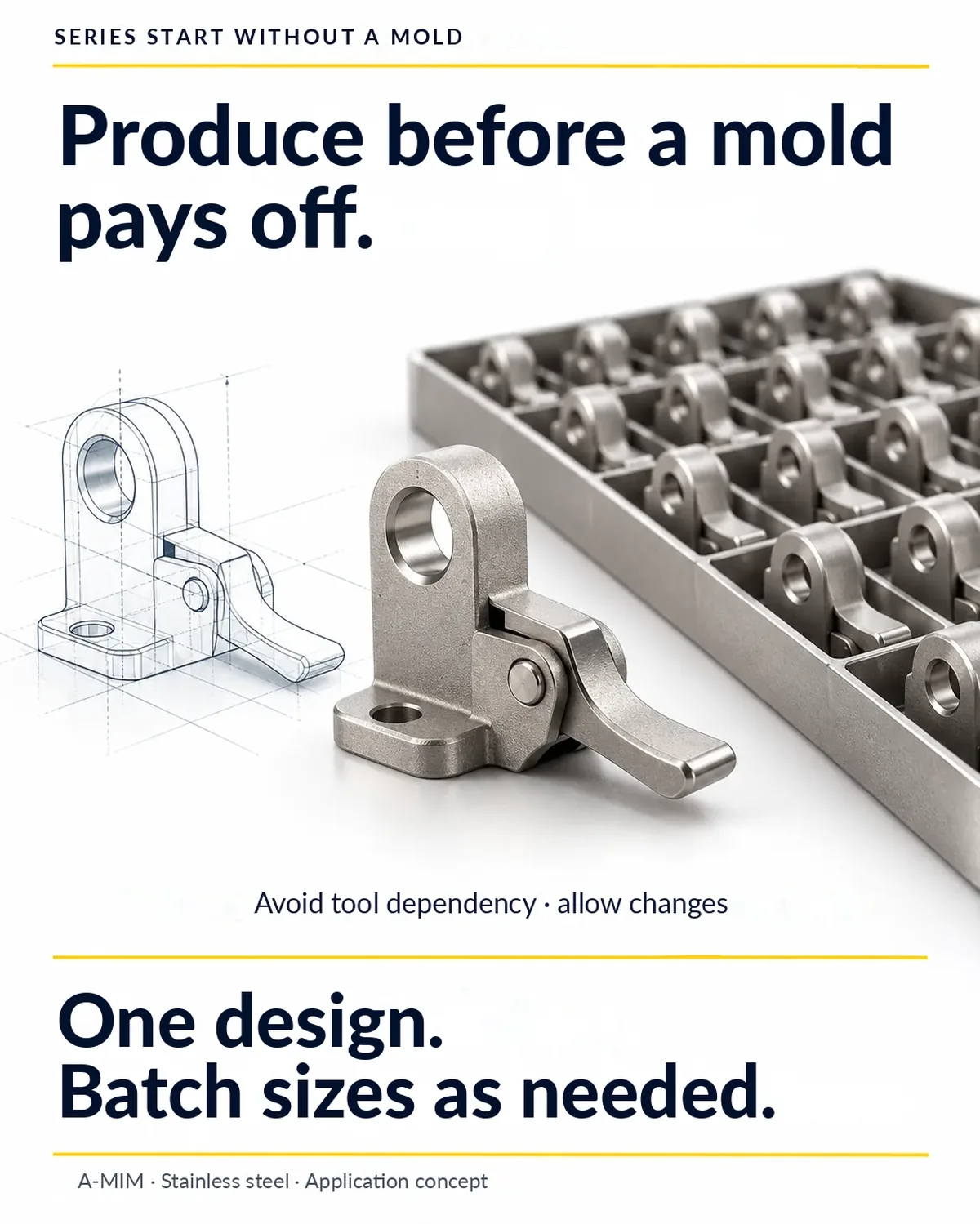
Between 250 and 50,000 pieces per year, A-MIM can be of interest. What matters is whether this quantity falls on one identical version – or, for example, on 40 variants. Without part-specific tooling, a further variant does not cost new tooling – but, depending on the change, it does require a renewed assessment of manufacturing and sintering behavior.
At 50,000 identical, easily injection-moldable parts, conventional MIM must be included in the evaluation.
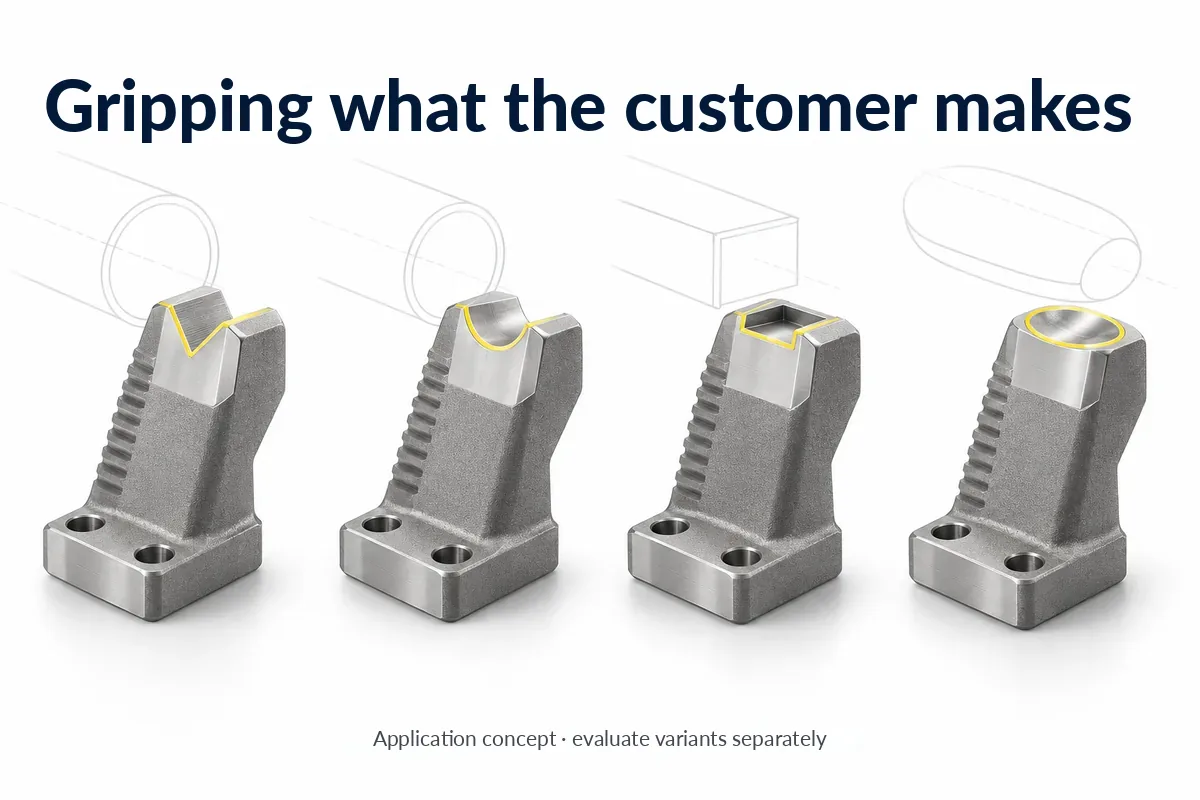
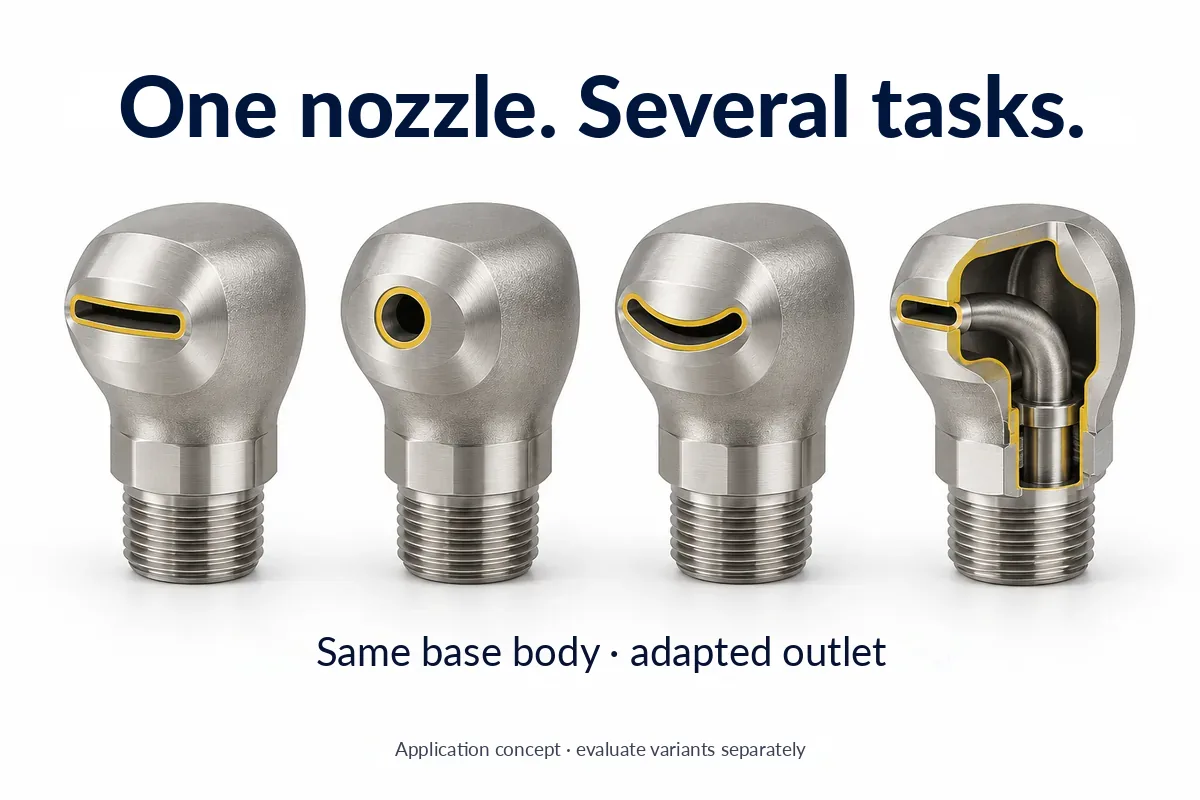
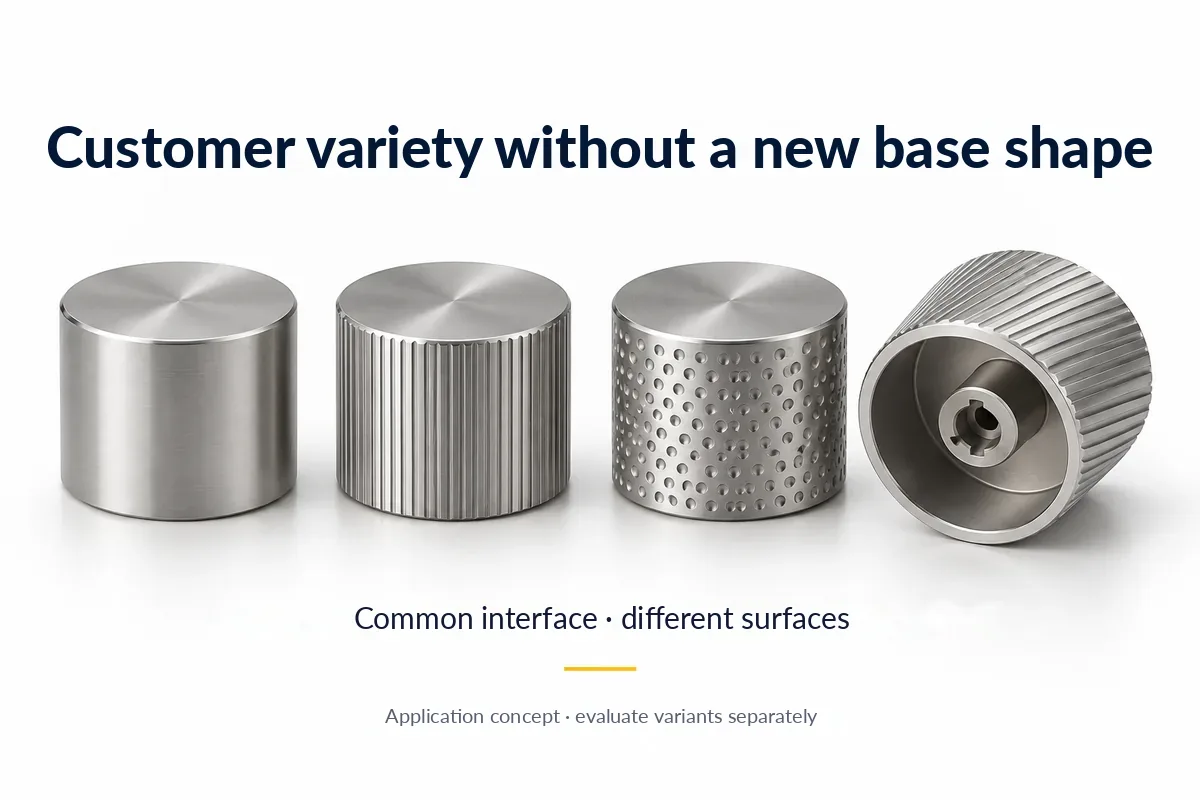
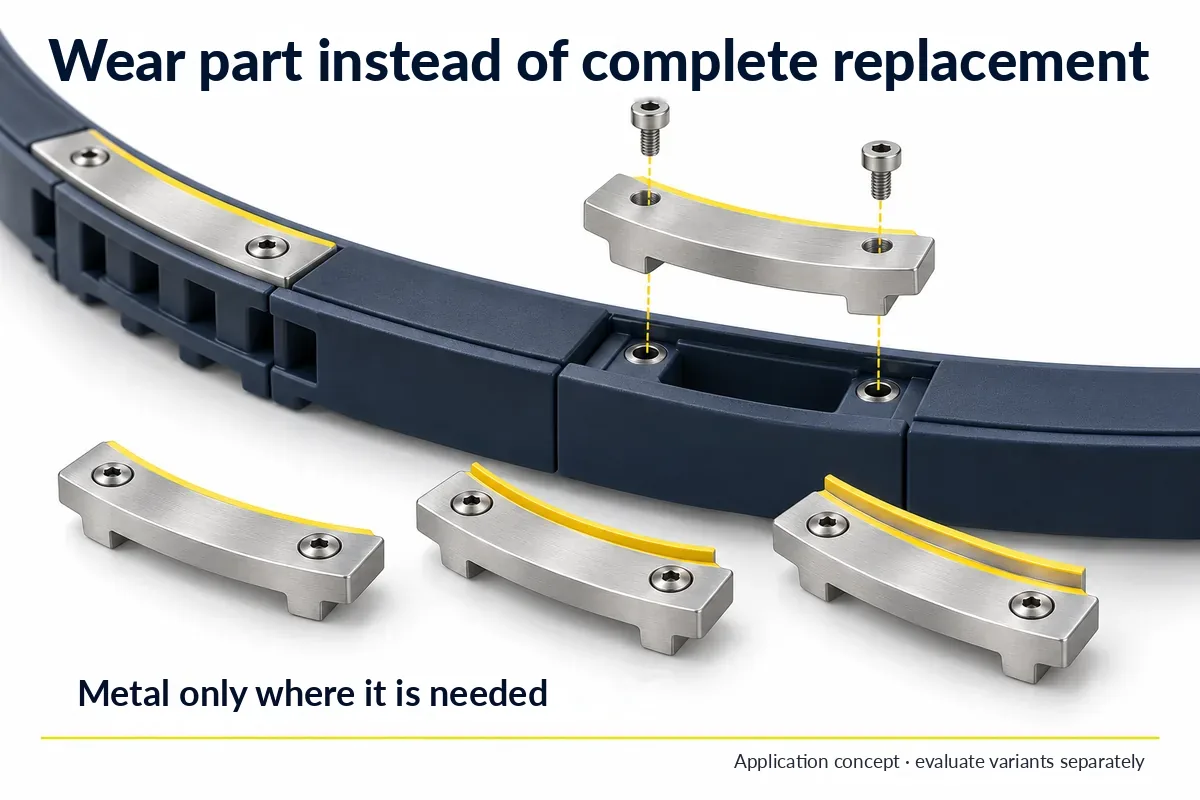
Gripping what the customer produces – same base, adapted gripping contourOne nozzle, several tasks – same base body, adapted outletCustomer variety without a new basic shape – common interface, different surfacesWear part instead of complete replacement – metal only where it is needed
Planning scenario
20 variants × 500 pieces = 10,000 parts of one family
For a single part at 500 pieces, a dedicated mold is rarely worthwhile – nor are 20 molds for 20 such variants. Viewed as a family, a quantity is reached that supports series production.
A planning scenario, not a claimed cost saving. Whether it pays off is shown by the calculation for the specific family.
Six benefit arguments – even without variant diversity
How variant diversity becomes a manageable manufacturing approach
This order is the most favorable – the further down, the more has to be reassessed:
1
Identical as-sintered blank, different rework
Threads, fits or hole patterns are produced later in a customer-specific way. The sintered geometry actually stays the same.
2
Slightly different green parts
Flat inscriptions, textures and small local contour changes. Whether existing sintering experience can be transferred is checked.
3
Changed material distribution
Different channels, wall thicknesses, overhangs or large cutouts. This is a new geometric assessment – even with the same outer envelope.
For a family, material, wall thickness distribution, orientation, support and process control should stay as constant as possible. The same outer dimensions or the same weight alone are not enough.
Applications by industry
The quantities are suggested evaluation ranges per year across the entire part family, not proven economic limits.
Automation250–5,000 pieces/year
Gripper fingers and gripper inserts
Starting situation
The gripper stays the same, the customer product changes – today often with milled one-off designs.
Possible advantage
Complex fingers with integrated air routing, one variant per customer product without dedicated tooling.
Still to be done
Post-process mounting and contact surfaces.
Sensible variants
Same base, back and length; adapted flat gripping contours.
Feeding technology500–10,000 pieces/year
Guide inserts and singulating elements
Starting situation
Plastic guides wear at heavily stressed points and are replaced completely.
Possible advantage
A small metal insert protects the stressed area; when it wears, only the insert is replaced.
Still to be done
Machine the fit to the guide and the mounting.
Sensible variants
Same mounting and underside; adapted guide groove or stop contour.
Cleaning systems1,000–50,000 pieces/year
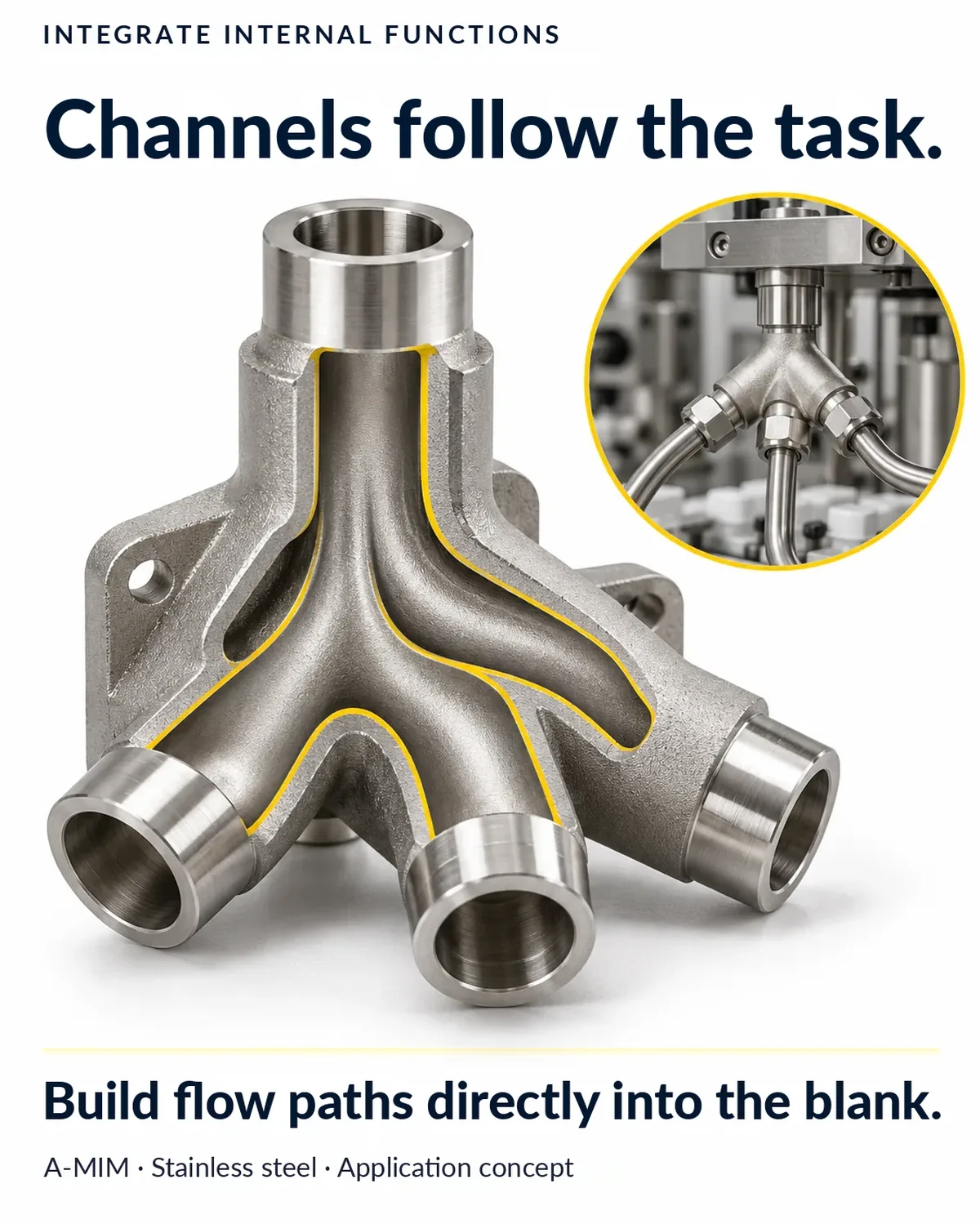
Compact special nozzles
Starting situation
Flow paths are drilled or assembled from several parts.
Possible advantage
The flow routing is created in the blank; several functions can be combined in one nozzle body.
Still to be done
Machine the connection and outlet where required, check the flow pattern.
Sensible variants
Same body and connection; limited changes at the outlet. Assess larger channel changes separately.
Dispensing and adhesive technology500–10,000 pieces/year
Mixing and distribution heads
Starting situation
Bolted adapters and long internal paths for different system connections.
Possible advantage
One base body with shorter internal paths serves different connections.
Still to be done
Define threads as late as possible through rework, check leak tightness.
Sensible variants
Same basic channel structure and connection bosses; different threads, if possible only through rework.
Sensing1,000–25,000 pieces/year
Protective heads and sensor mounts
Starting situation
Protection, mounting and cable routing are separate parts and differ for each installation situation.
Possible advantage
The functions are consolidated in one part; a product platform adapts to installation situations.
Still to be done
Machine connection threads; check leak tightness depending on the application.
Sensible variants
Same wall thicknesses and support; vary connection threads, marking and small mounting contours.
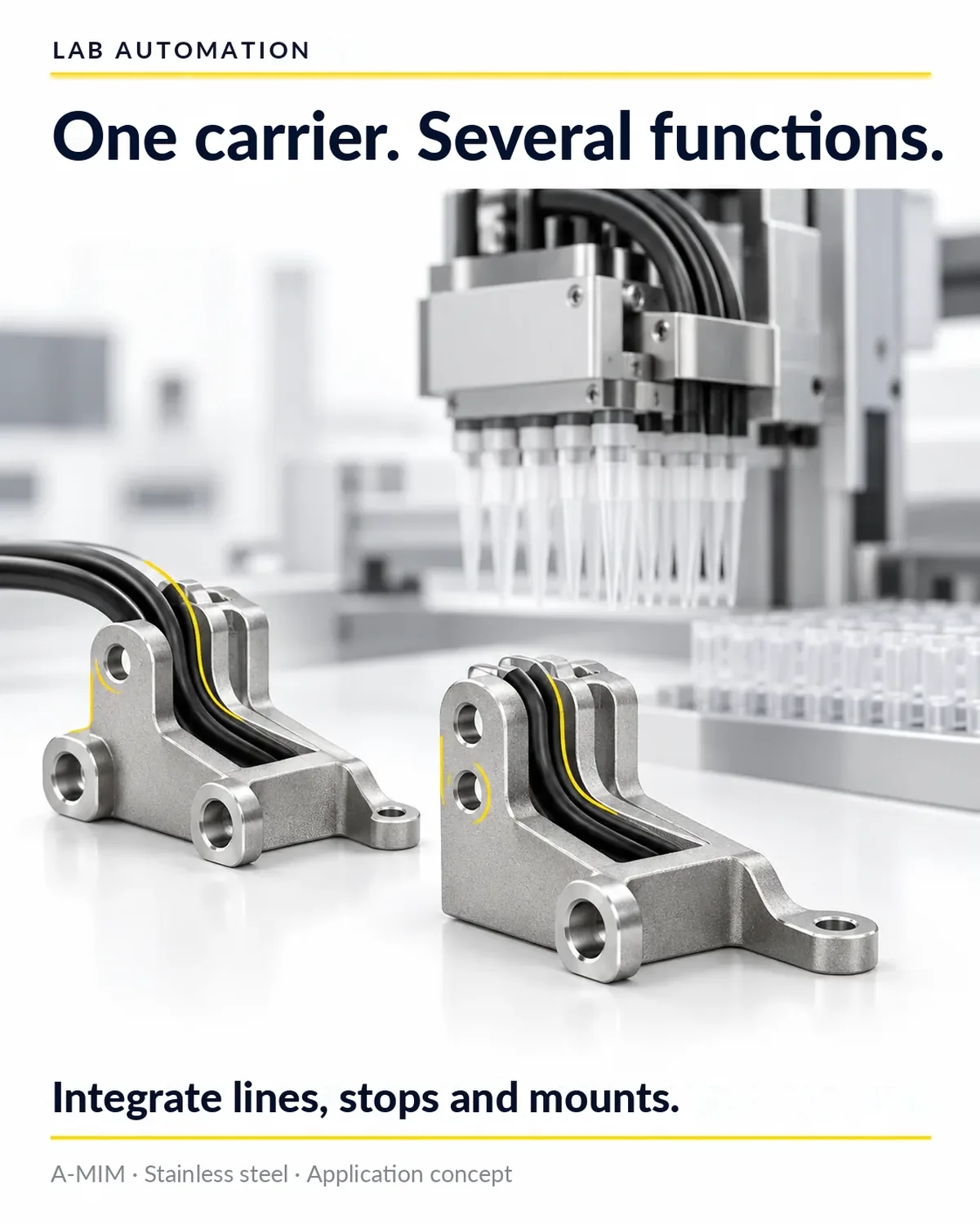
Laboratory automation250–5,000 pieces/year
Carriers for pipetting and gripper modules
Starting situation
Carrier, line routing, stops and mountings are several parts.
Possible advantage
A compact carrier integrates line routing, stops and mountings.
Still to be done
Machine bearing, guide and mounting surfaces.
Sensible variants
Same load-bearing structure; different hole patterns or local seats within defined areas.
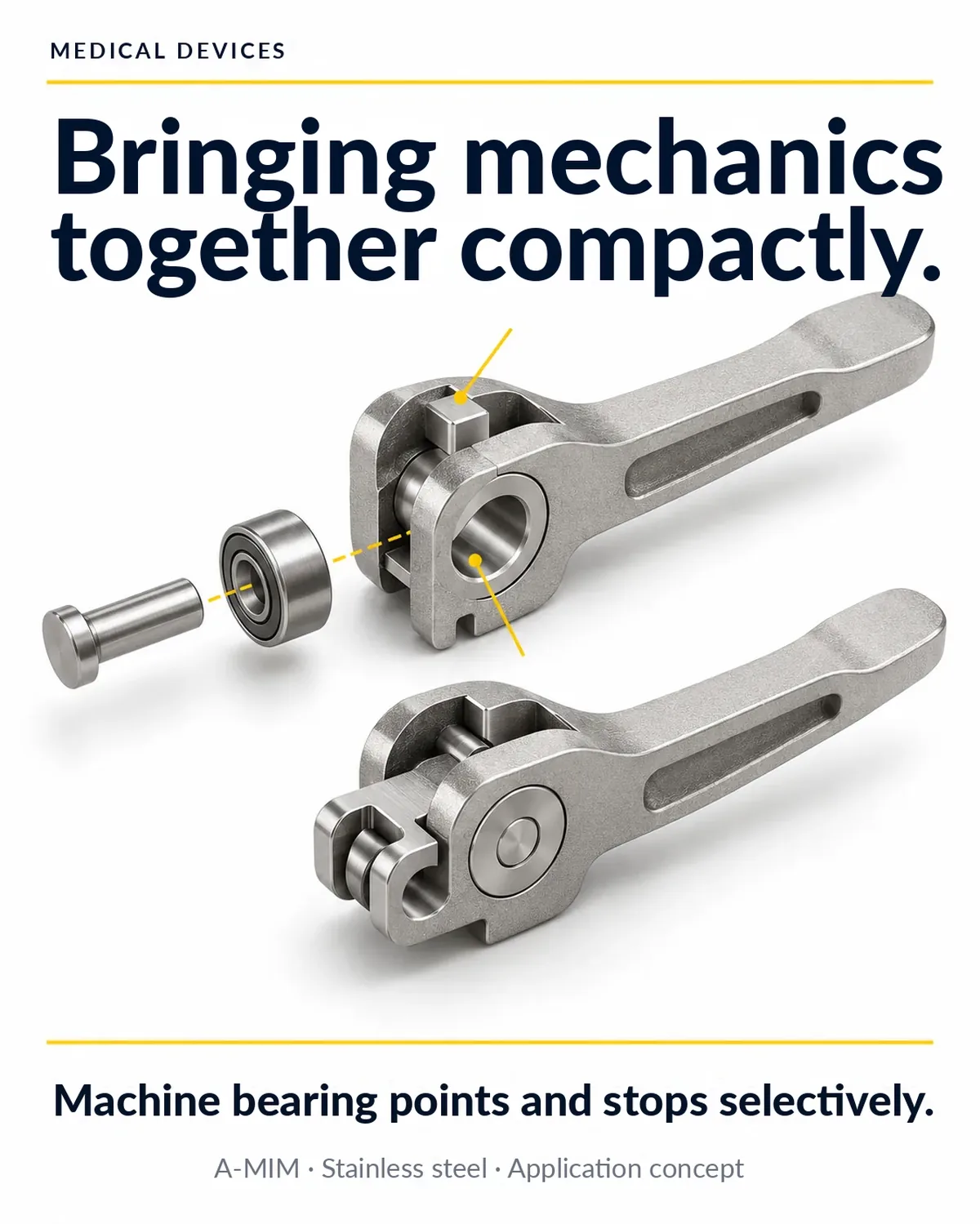
Medical devices1,000–20,000 pieces/year
Internal locking and coupling parts
Starting situation
Several machined individual parts together form a small mechanism.
Possible advantage
A compact mechanical part with hard-to-reach pockets and integrated stops.
Still to be done
Machine the bearing area; inspection and documentation depend on the device requirements.
Sensible variants
Same bearing area and cross-section; local actuation or connection contour.
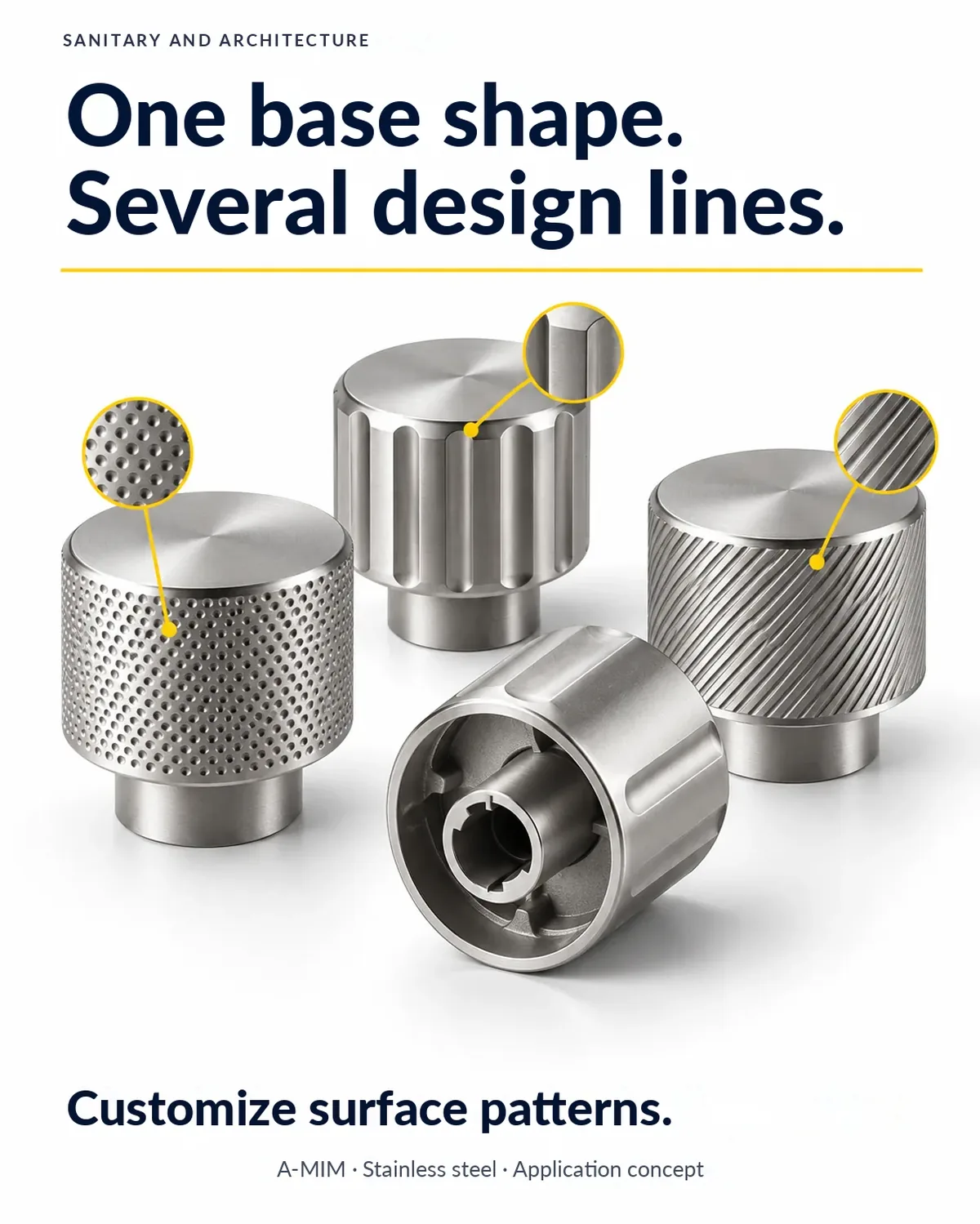
Sanitary and architecture2,000–50,000 pieces/year
Operating handles and fittings
Starting situation
With mold-based processes, every design line would need its own tooling.
Possible advantage
Different surface patterns with a common mechanical interface, without separate tooling per line.
Still to be done
Plan for surface finishing – it belongs in the calculation.
Sensible variants
Flat textures, lettering and patterns on the same hollow body.
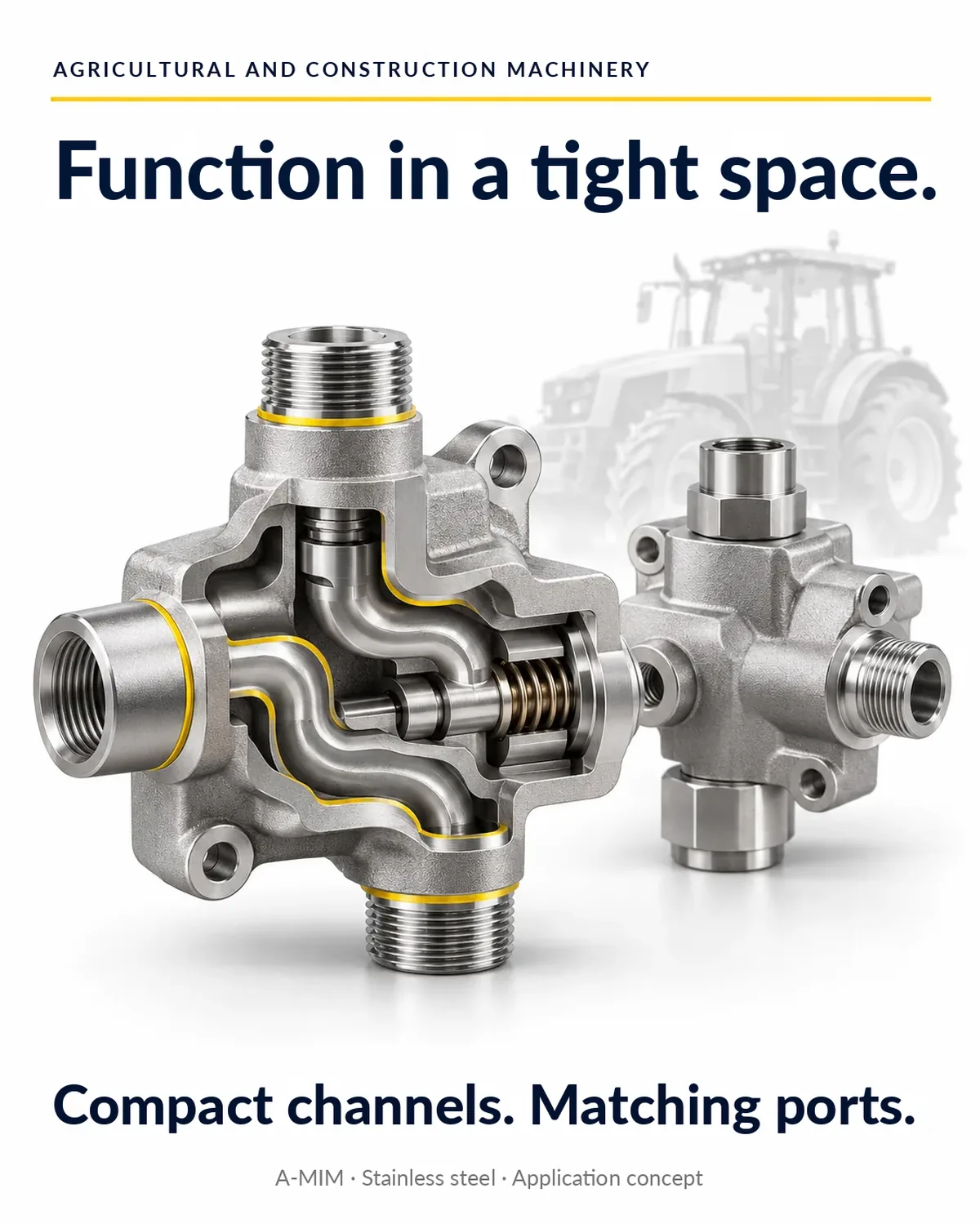
Agricultural and construction machinery5,000–50,000 pieces/year
Small valve and bypass bodies
Starting situation
Tight installation space; every platform variant gets its own body.
Possible advantage
Compact flow paths in a common envelope, variants via suitable connections.
Still to be done
Machine connections, check leak tightness.
Sensible variants
Same envelope, channel structure and material distribution; vary connection machining and marking.
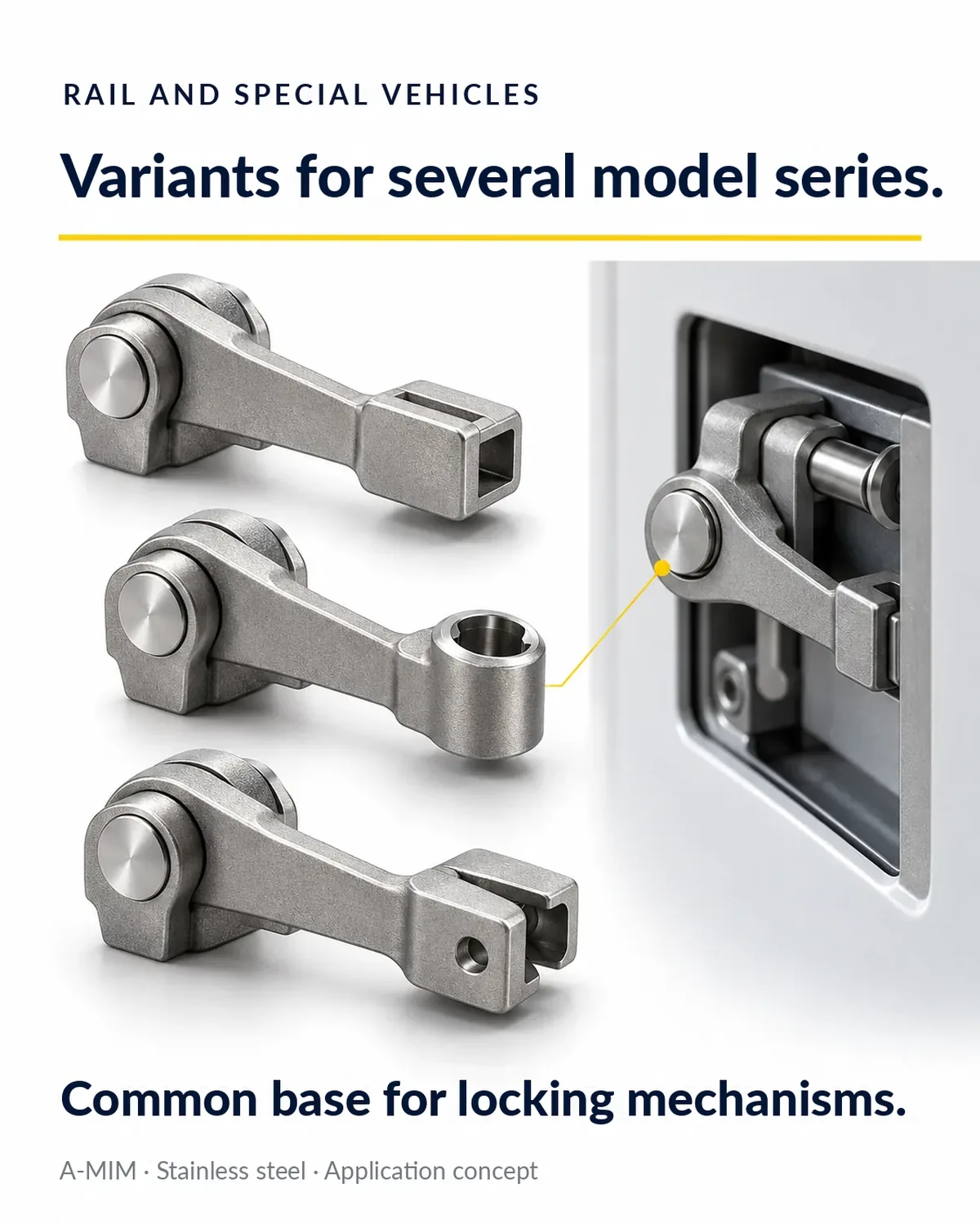
Rail and special vehicles250–5,000 pieces/year
Latch mechanisms for interior fittings
Starting situation
Several product series need similar but not identical locking parts in small quantities and as spare-part demand.
Possible advantage
Small series and spare-part demand are produced as a part family, without tooling per variant.
Still to be done
Machine the bearing area and stop.
Sensible variants
Same base body and bearing area; limited changes to the actuation seat and stop.
Two further starting points
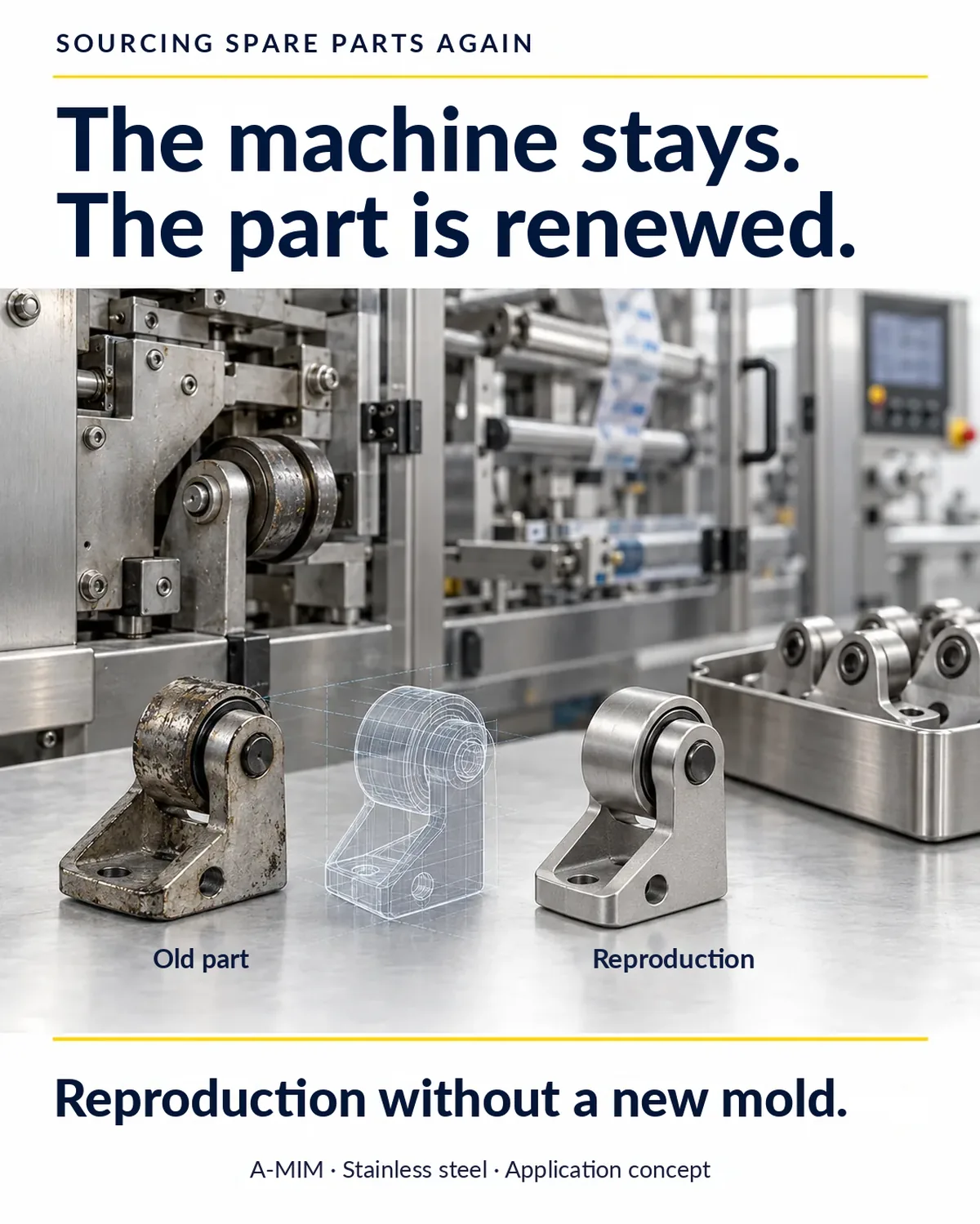
Spare parts without new tooling
Starting situation
A part is no longer available; the old tooling is missing or not worthwhile for the small demand.
Possible advantage
Reproduction from CAD data – if necessary after reverse engineering the old part – without tooling.
Still to be done
Machine functional surfaces, check fit and function at the installation location.
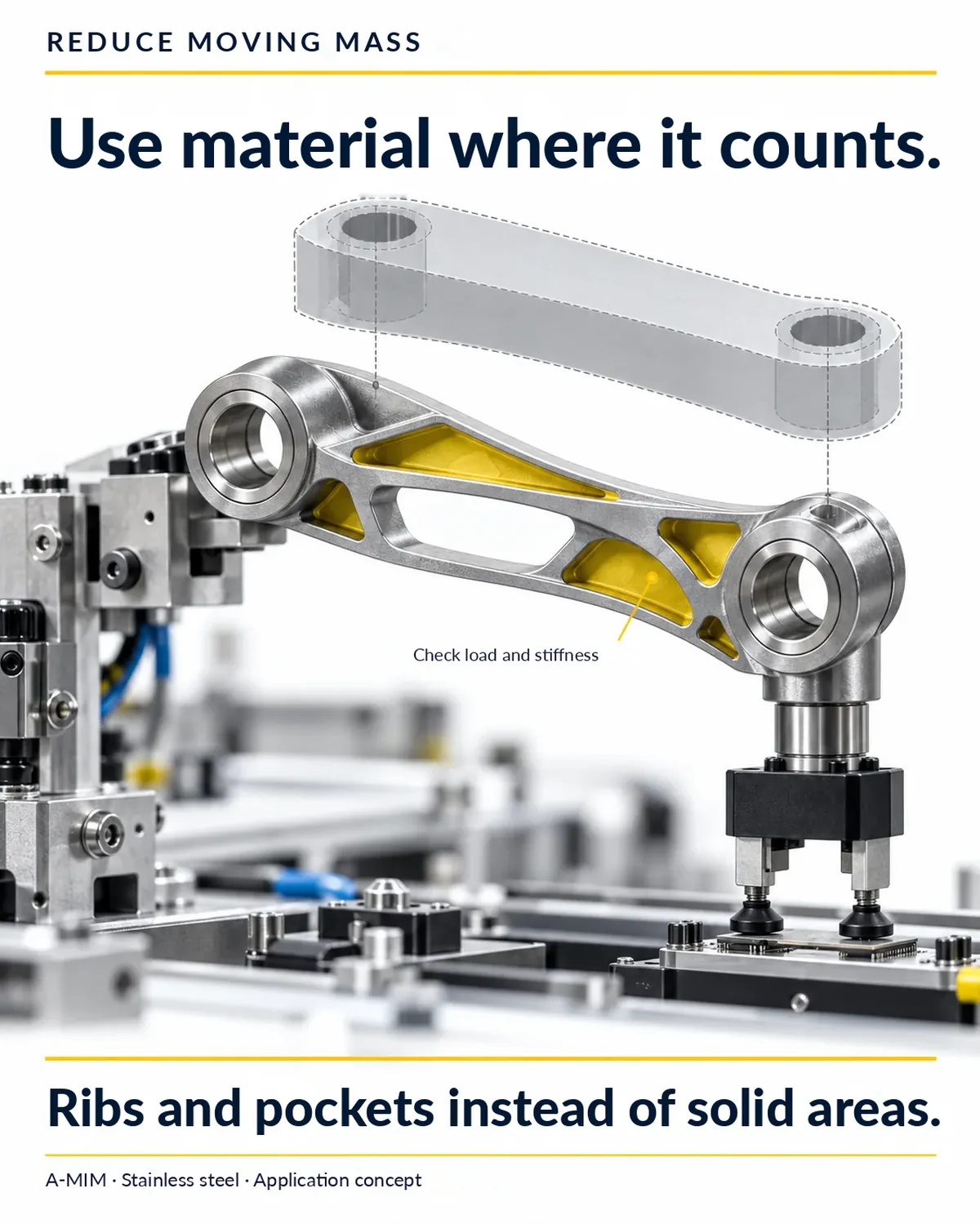
Reduce moving mass
Starting situation
Solid levers and arms increase the moving mass of fast axes.
Possible advantage
Ribs and pockets instead of solid regions – material only where the load path runs.
Still to be done
Verify loading and stiffness, machine bearing and connection surfaces.
What others already show
Two published approaches that these concepts build on. Prices and quantities from them cannot be transferred to FIT.
Metal only where wear occurs
The feeding technology manufacturer IFC Intelligent Feeding Components uses a mechanical metal baffle produced by metal binder jetting in its vibratory bowl feeders. According to managing director Andreas Schirmer, it solves the rapid wear where polymer-based parts were not sufficient. IFC prints 17-4PH and 316L, among others, for this.
Fluidic oscillators produce an oscillating cleaning jet solely through their internal channel routing: part of the jet flows back through a feedback channel and deflects it to the opposite side – without moving parts. Precisely such internal geometries are created in the blank in A-MIM.
Three typical starting situations, thought through step by step: current solution, problem, A-MIM logic, post-processing. Costs and lead times only emerge from a calculation on the specific part.
3-part welded assembly with separate channel bores. Complex assembly, leak test at 2 weld seams.
Problem
High assembly effort. Every weld seam is a potential leak. Channel geometry restricted by drillability.
Goal
One part, reliably sealed, free channel routing, less handling in manufacturing.
A-MIM logic
Manifold block as a sintered part with integrated internal channels. Channel geometry freely designed – not limited by drilling axes. Wall thicknesses designed uniformly.
Post-processing
Only sealing seats at the connections turned. Threads cut afterwards. Otherwise as-sintered blank.
Result
From 3 parts to 1. Weld-related leak points are eliminated; the leak tightness of the part is still verified. Channel geometry optimized rather than compromised.
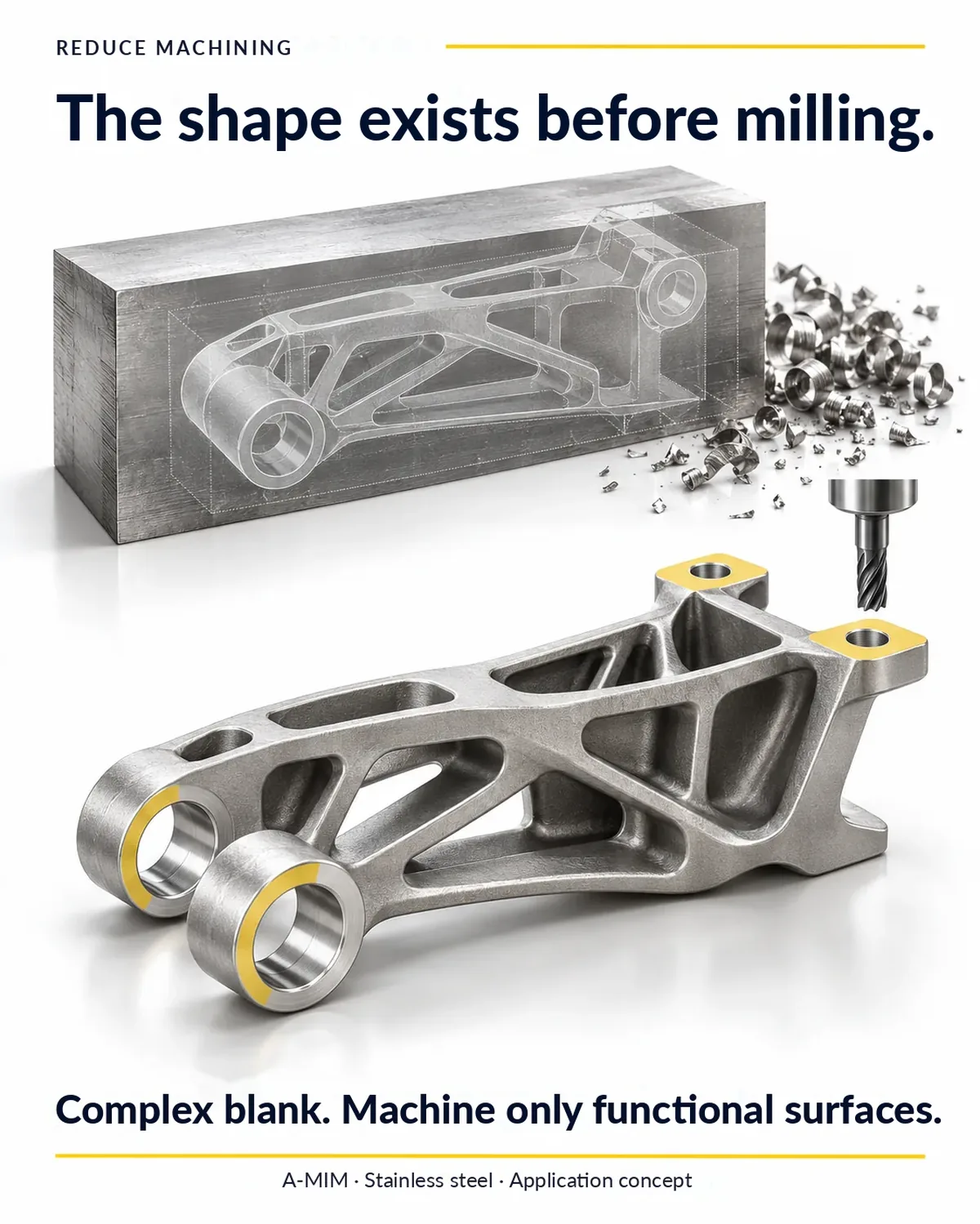
Milled part from solid material, 12 setups, high setup costs, 6 weeks lead time from raw material.
Problem
Manufacturing effort disproportionate to part complexity. Unit costs too high for a medium-sized series. Long lead time blocks development iterations.
Goal
Shift complexity into the blank. Reduce machining effort to a minimum. Lead time under 3 weeks.
A-MIM logic
Complex external and internal geometry directly as a sintered part. Undercuts and pockets integrated in the blank. Machining allowance provided only on 2 mating surfaces and 1 datum surface.
Post-processing
2 mating surfaces milled, 1 datum surface ground. 3 setups instead of 12.
Result
3 instead of 12 setups. Geometric degrees of freedom increased – not restricted. Lead time and unit costs are calculated on the specific project.
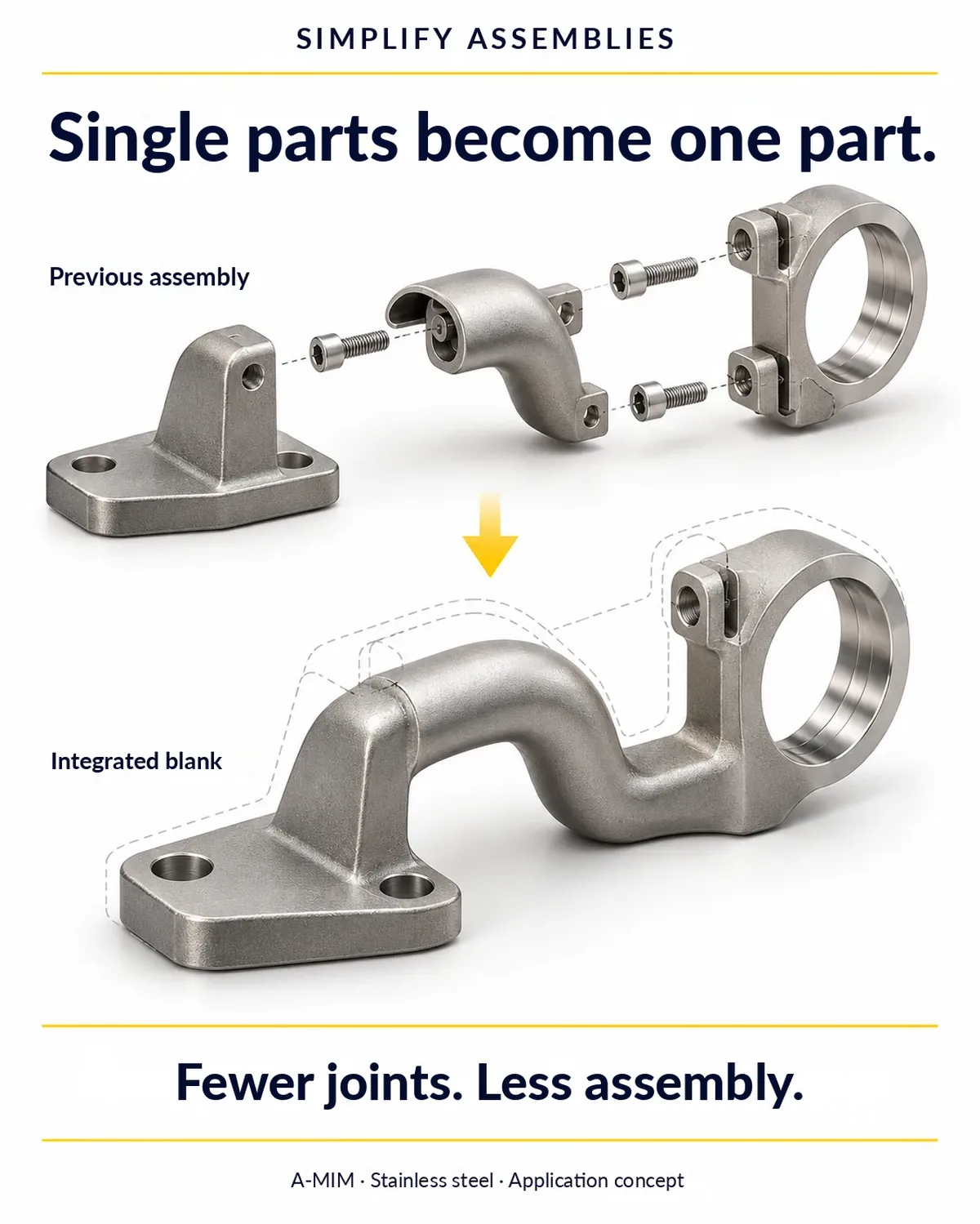
2-part solution: cast part as base body, sheet-metal cover, joined by welding. Internal geometry limited by casting.
Problem
Wall thicknesses limited by casting. Internal geometry cannot be designed freely. 2-part assembly creates a weld seam as a critical area.
Goal
One part. Free internal geometry. No assembly. No weld seam.
A-MIM logic
One-piece sintered housing. Internal channels and pockets directly in the blank. Outer surfaces remain as-sintered – no machining needed.
Post-processing
1 internal thread cut afterwards. Sealing surface at the cover connection milled. Otherwise as-sintered blank.
Result
2-part solution reduced to 1 part. Assembly and weld seam eliminated. Internal geometry optimized. Whether the total costs fall is shown by the calculation on the specific part.
Check your own part? Upload CAD and view it in the 3D viewer.