Process comparison
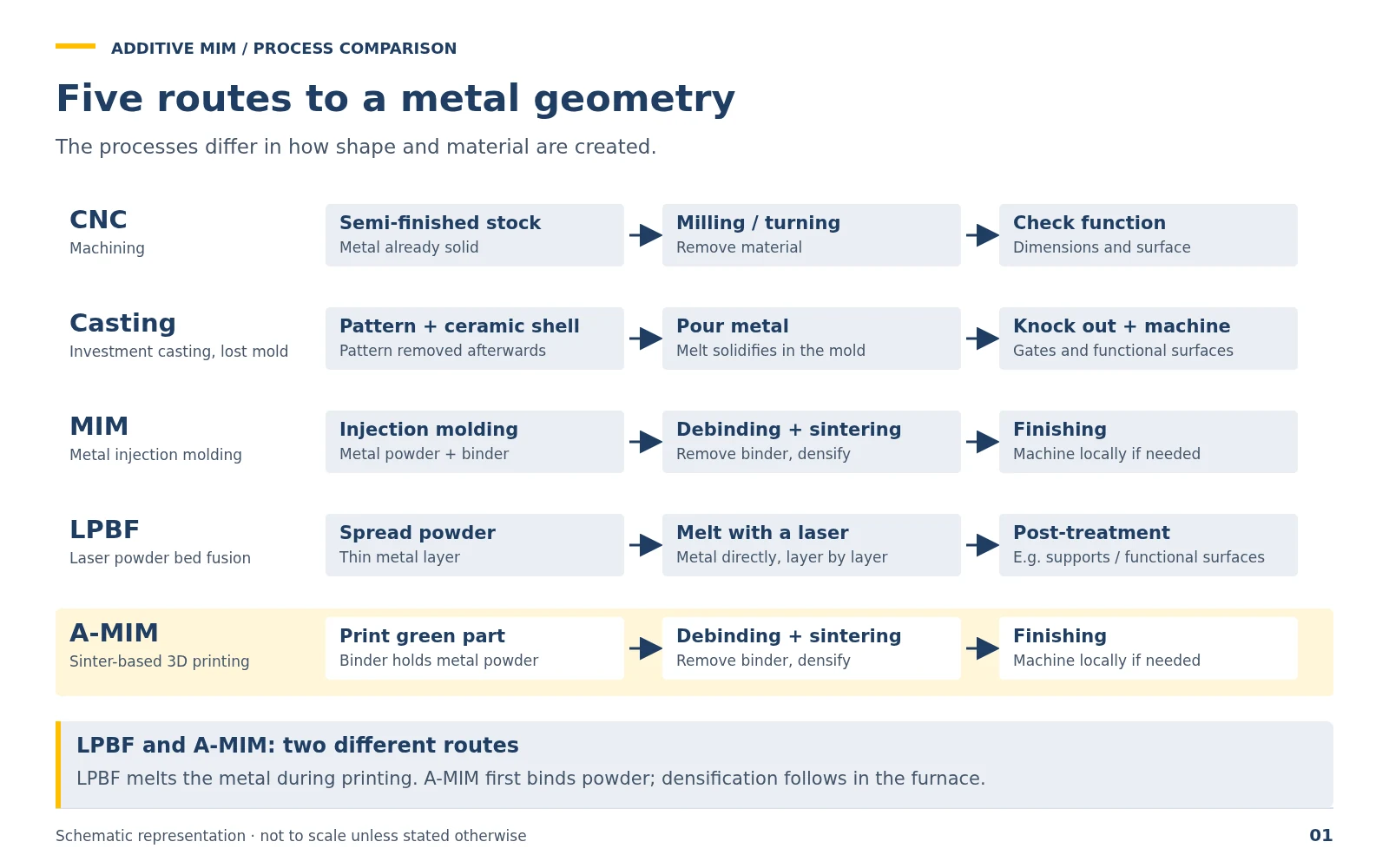
A-MIM in the context of conventional and additive manufacturing processes.
Comparison of processes
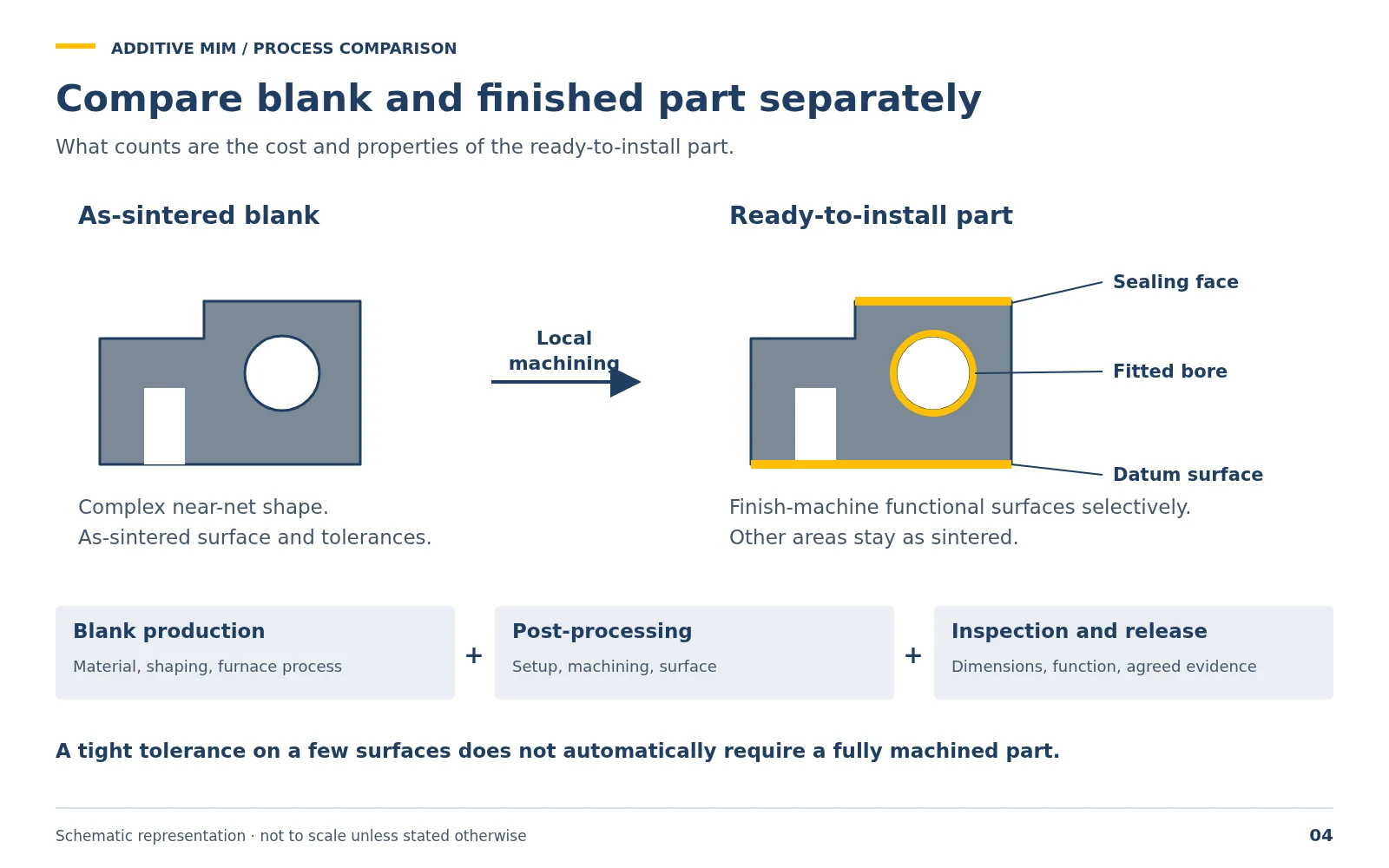
What is compared is the ready-to-install part – including required tooling, fixtures, post-processing and inspection. Costs, lead times and tolerances depend so strongly on the part that the table deliberately does not give blanket figures. Sizes and quantities are guideline values, not hard limits.
| Process | Of interest when … | One-time effort | Geometric constraints | Internal channels | Typical post-processing | Strongly part-dependent |
|---|---|---|---|---|---|---|
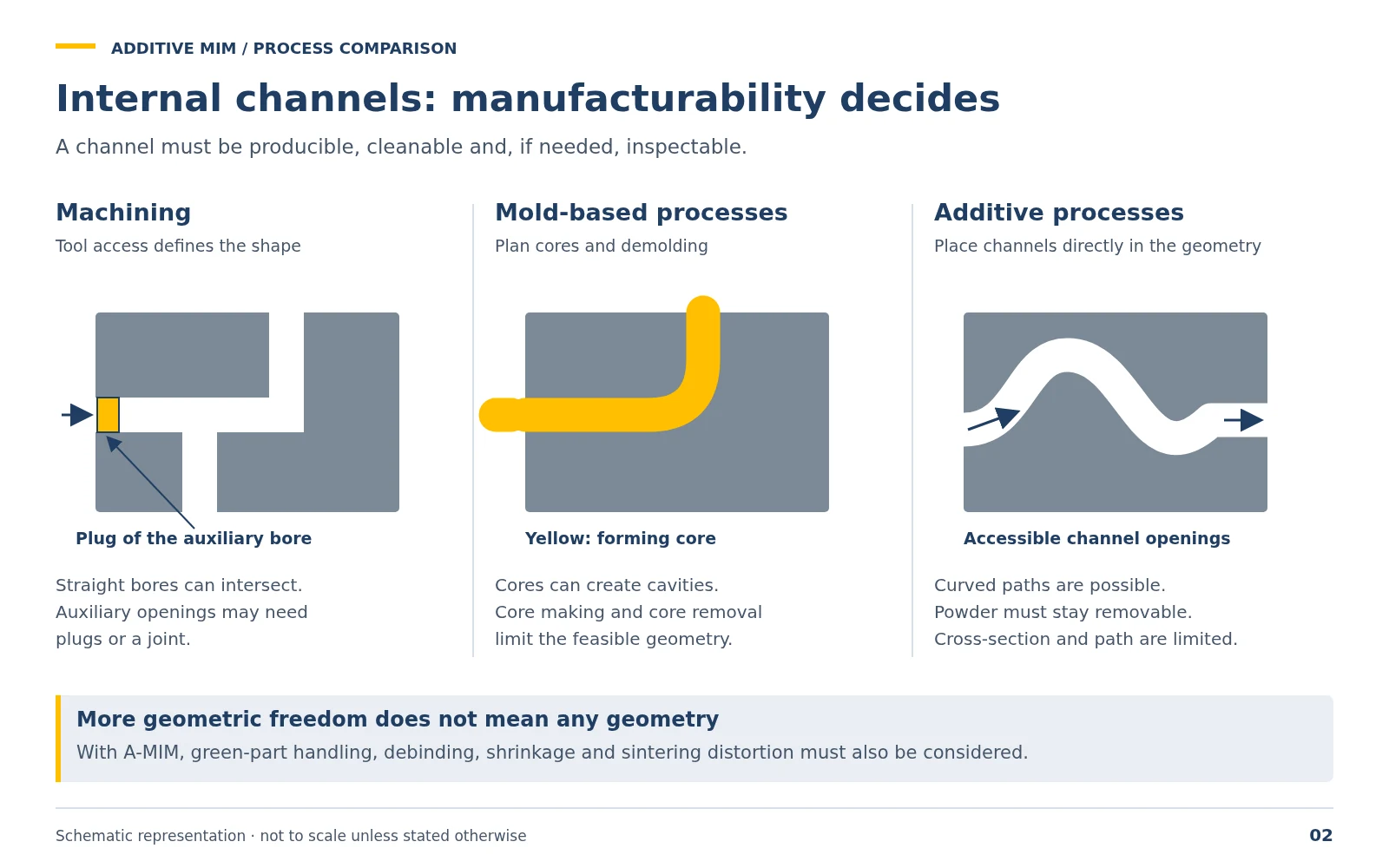
| CNC machining | Simple to medium geometry, high accuracy on many surfaces, single parts to series | Programming, fixtures, cutting tools – no part-specific mold | Tool access: internal shapes only via bores, undercuts costly | Limited: straight bores, possibly with plugs | Deburring, if applicable heat treatment and grinding | Machined volume, number of setups, material input |
| Investment casting | Complex outer shapes, also larger parts, recurring series | Tooling for the wax patterns; one expendable ceramic shell per part | Casting-oriented design (wall thicknesses, gating), cavities via cores | Limited: via cores | Remove gating, machine functional surfaces | Tooling cost relative to quantity, scrap, extent of machining |
| MIM (metal injection molding) | Small complex parts in high, constant quantities – include it in the evaluation from about 50,000 identical parts per year | Injection mold – high one-time effort, changes costly | Demoldability and parting line, shrinkage during sintering | Limited: via cores and parting | As with A-MIM: functional surfaces where required | Quantity at which the tooling pays for itself |
| Laser powder bed fusion (LPBF) | Very complex geometries, lightweight design, single parts and small quantities – usually more economical than A-MIM up to about 50 pieces | No mold; build preparation, support structures | Support structures for overhangs, residual stresses | Yes – powder must be removable | Separate from build plate and supports, heat treatment, functional surfaces | Build height, build-space utilization, support effort |
| A-MIM | Complex parts up to about 150 × 100 × 80 mm and 60 cm³, variants and part families, about 250 to 50,000 pieces per year across the family | No mold; process design (orientation, sintering support, shrinkage compensation) | Handling of the green part, depowdering, shrinkage and warpage during sintering | Yes – powder must be removable | Fits, threads, sealing seats where required | Build-space utilization, sintering supports, extent of machining |
Classification
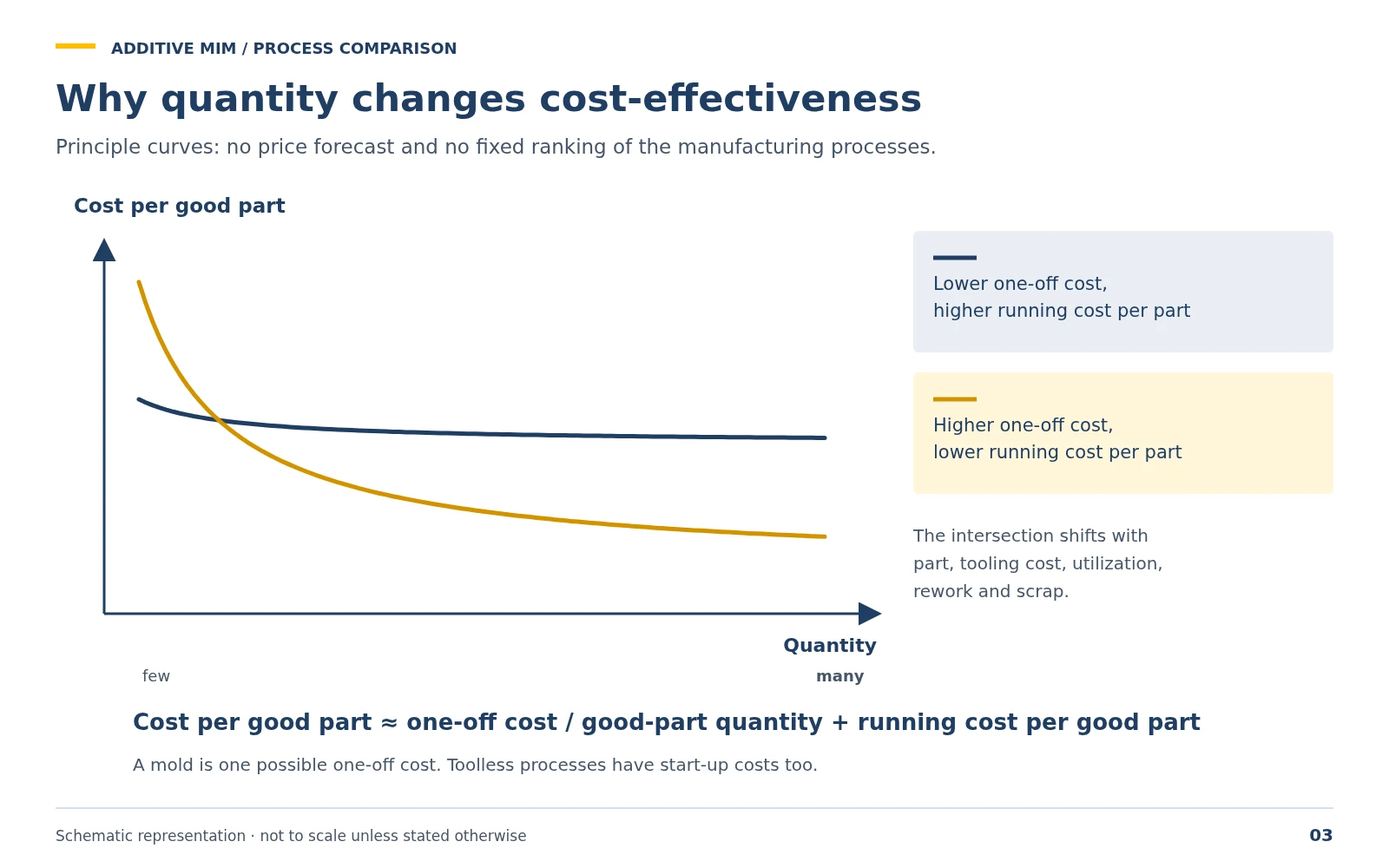
There is no fixed ranking – where A-MIM stands economically is decided by the part. Typical tendencies:
- Compared with CNC usually at an advantage with complex geometry, large machined volume and medium quantities
- Compared with LPBF usually at an advantage when many identical parts are produced – for single parts and small quantities of up to about 50 pieces, LPBF is usually more economical
- Compared with MIM usually at a disadvantage at very high quantities, once the injection mold pays for itself
- Compared with investment casting and MIM usually faster to the first sample, because no part-specific mold has to be built
The right choice of process depends on geometry, quantity, tolerance requirements and time pressure – the ready-to-install part should always be compared, not just the blank.