
J+G – Production Aids for Your Own Manufacturing
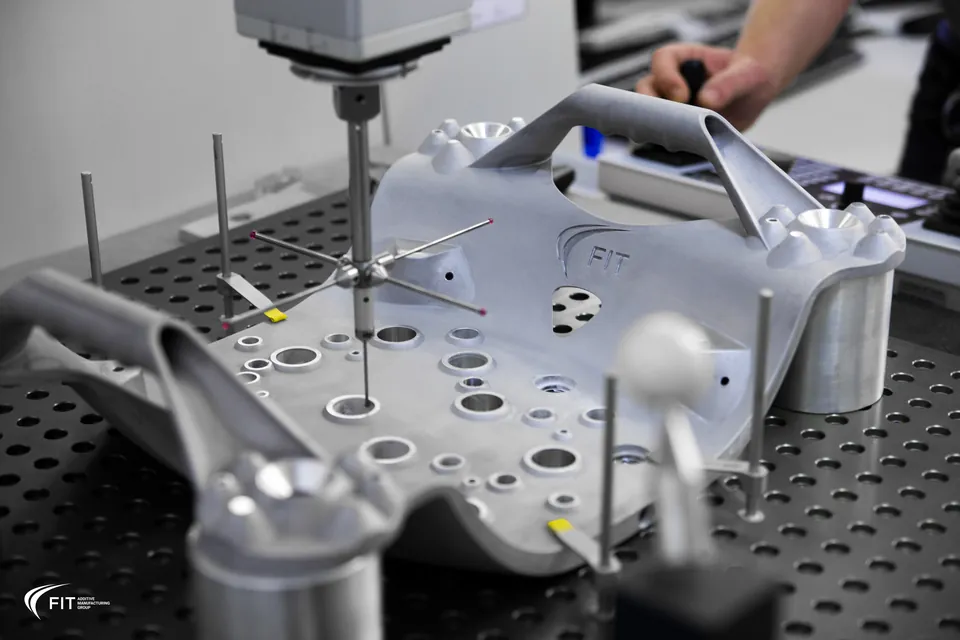
J+G stands for Jigs & Grips: fixtures, locating fixtures, assembly and inspection gauges, drill templates, gripper fingers, transport plugs and moulded inserts for safe transport within production. The question is rarely “print or not,” but rather: which process for which part – additive, vacuum casting, injection-moulded or elastomer parts, or combined with profiles and laser-cut blanks.
What J+G includes
Fixtures and gauges
Assembly, joining, bonding and inspection gauges, drill templates, measuring and clamping fixtures.
Gripping and handling
Gripper jaws and fingers, suction gripper carriers, end effectors, workpiece carrier nests.
Transport and protection
Transport plugs, protective caps, moulded inserts and impact protection for the path through production.
Tooling
Special tools, embossing dies, cutting, deep-drawing and RIM tools, injection moulds for small series.
FIT manufactures these production aids according to its own statement (Rapid Tooling, Conventional processes).
Where the advantages come from
Every advantage comes with a condition. Below each one it states when it matters and what to check in the individual case.
Contour taken directly from the workpiece
A locating fixture is essentially the negative of the workpiece. In additive manufacturing, this contour is derived from the workpiece CAD and printed – without a milling program, without 5-axis machining for freeform surfaces, without a mould.
Matters for: Freeform surfaces, undercuts, multiple support points in one part.
Check: Datum points with tight tolerances – provide a pin or bushing there.
Variants and product changeovers
Each variant is a file. For a product changeover, only the locating fixture is reprinted; the base plate, clamps and frame remain.
Matters for: Many variants, frequent design changes, ramp-up before series production.
Check: Whether the changeover part is clearly marked and mix-up-proof.
Less moving mass
Gripper fingers and end effectors are accelerated with the robot; the inertial force grows with mass (F = m · a). Fingers half as heavy mean half the inertial force at the same acceleration – more reserve for payload or cycle time.
Matters for: Fast pick-and-place motions, long lever arms, payload at the limit.
Check: Stiffness and deflection of the lighter finger under the gripping force.
Functions within the part
Vacuum channels, cable guides, sensor and magnet mounts, snap-fit lugs or spring elements are printed along with the part. An assembly with hoses and screws becomes a single part.
Matters for: Suction grippers, inspection fixtures with sensors, fixtures with many small parts.
Check: Tightness of the channels and accessibility for cleaning.
Avoiding errors in assembly
Part number, insertion direction and variant ID are moulded in, each variant in its own colour. The shape permits only the correct insertion – the workpiece fits in one orientation only.
Matters for: Assembly with many variants, semi-skilled staff, inspection and bonding gauges.
Check: Whether the coding really rules out operator error – test it at the workstation.
Available fast when needed
Without tool making, a fixture is available in days instead of weeks. This matters during ramp-up, for prototype series and when a production problem has to be solved immediately.
Matters for: Ramp-up, pre-series, short-notice changes.
Check: Whether the quick solution has to be transferred to a series process later – see manufacturing strategy.
Where it does not fit
Simple plates and angle brackets, consumable parts in large quantities, high continuous load in plastic, datums with tight tolerances and fixtures larger than the build envelope – there are better routes for these. With guide values and rationale: Limits of J+G.