
Manufacturing strategy: which route for which production aid?
For production aids, the question is rarely whether 3D printing can do it. What matters is which route costs the least and works best over the entire service life. Three variables determine this: quantity, load and how often the part changes. FIT offers additive and low-volume-optimised processes from a single source – so the answer does not always have to be “print.”
Quantity: where each process sits
Output quantities per mould or tool according to fit.technology, Conventional processes and fit.technology, Additive plastic processes. More parts are possible with additional moulds; the bands show where a process typically sits, not hard limits.
Comparison of the routes
| Route | How | Strong for | Weak for | Quantity per FIT |
|---|---|---|---|---|
| Direct additive | SLS, SAF, FDM, SLA, PolyJet; metal by laser melting | One-offs and variants, complex contours, channels, lightweight design, fast ramp-up | High quantities of identical parts, simple geometry, true rubber properties | Up to about 1,000 parts (SAF: “several hundred to a thousand”) |
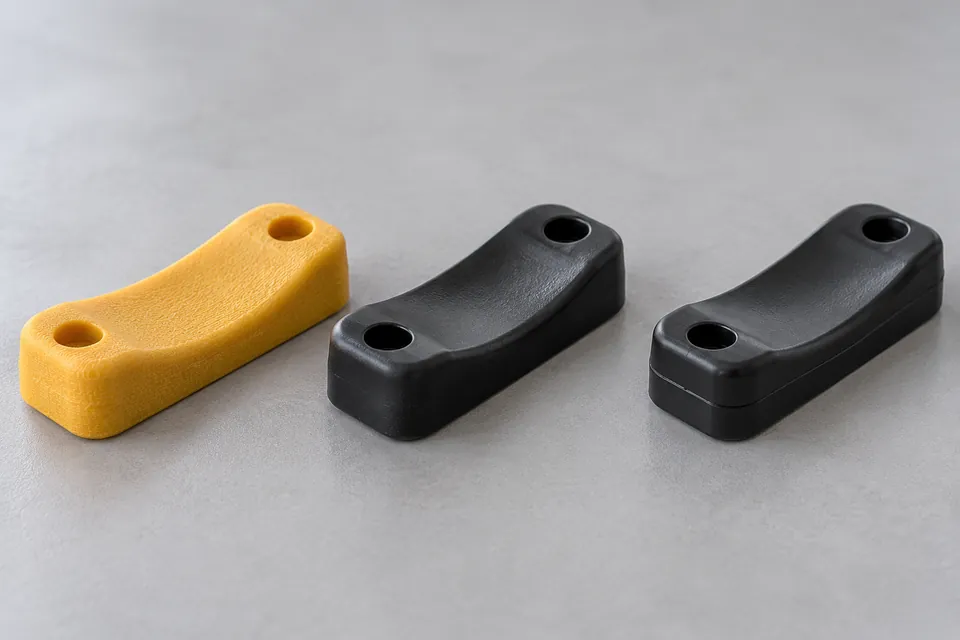
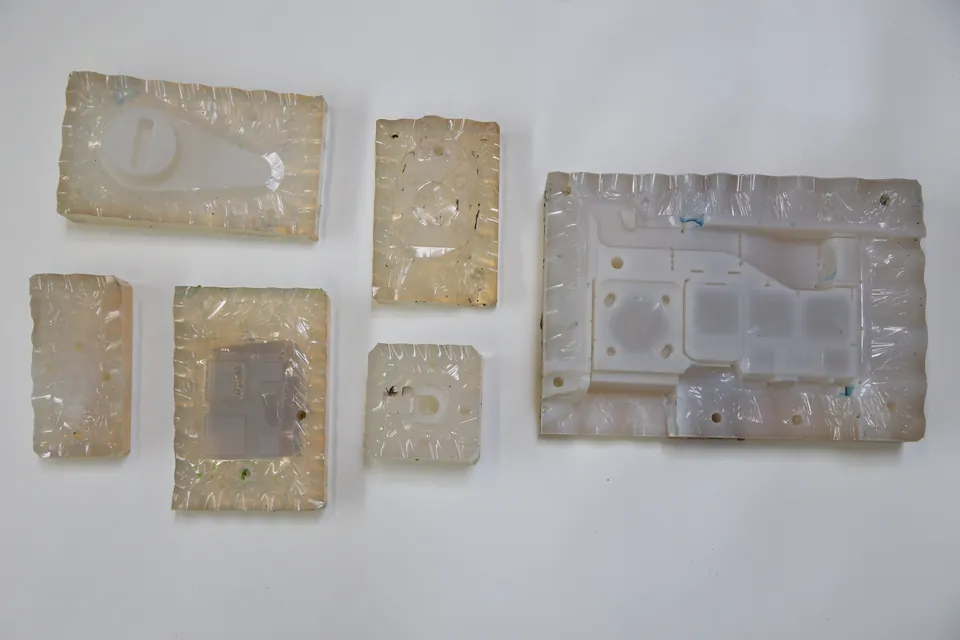
| Vacuum casting | Silicone mould from an SLA master model, PU resins | Soft or hard PU parts, surfaces comparable to injection moulding, contact pads, protective parts | Very high quantities, parts with high temperature or chemical load | 15–500 parts per mould |
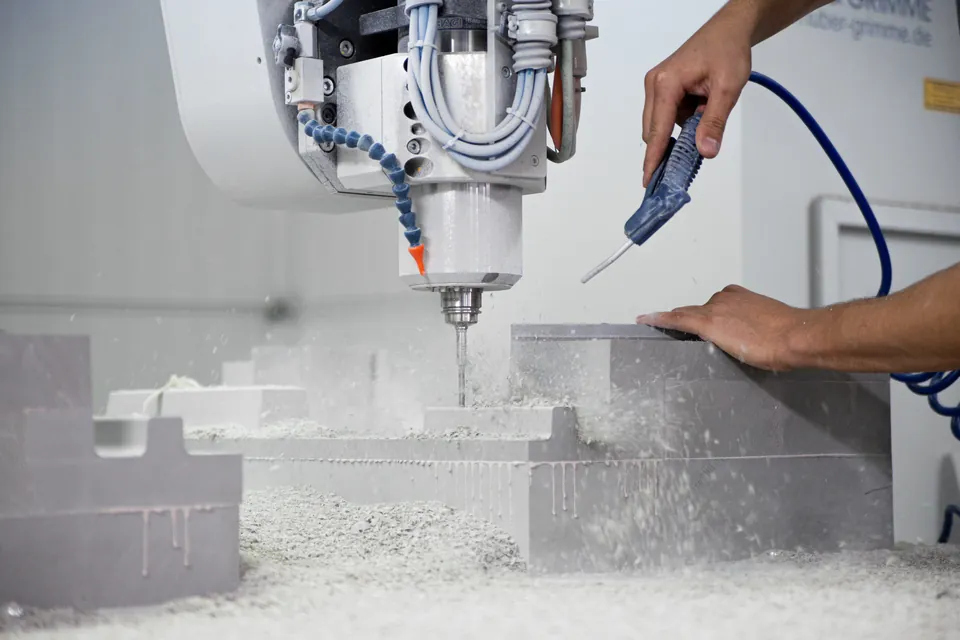
| Injection moulding with additive tooling | Tool made by laser melting from aluminium or steel | Clips, caps, plugs, holders in the original material; inserts can be overmoulded | One-offs, parts larger than 200 × 200 mm | 1,000–50,000 parts per tool |
| Elastomer production | Injection moulding (IM) or compression moulding (CM) of rubber compounds | Transport plugs, buffers, gripper pads, seals; bonded with bushings and threaded inserts | Few parts – then print additively or use vacuum casting | 1,000–100,000 parts per tool |
| Mould foaming Mould One Flex | PU foam in a printed single-use mould | Moulded inserts, cushioning, impact protection for transport and storage | Rigid, dimensionally accurate locating fixtures | Foam density e.g. 0.38 g/cm³ |
| Hybrid | Aluminium profiles, laser-cut blanks and purchased parts; only the contour made additively | Large fixtures, inspection and assembly stations, datums in metal | Small parts for which the frame costs more than the whole printed part | Size: beyond the build envelope |
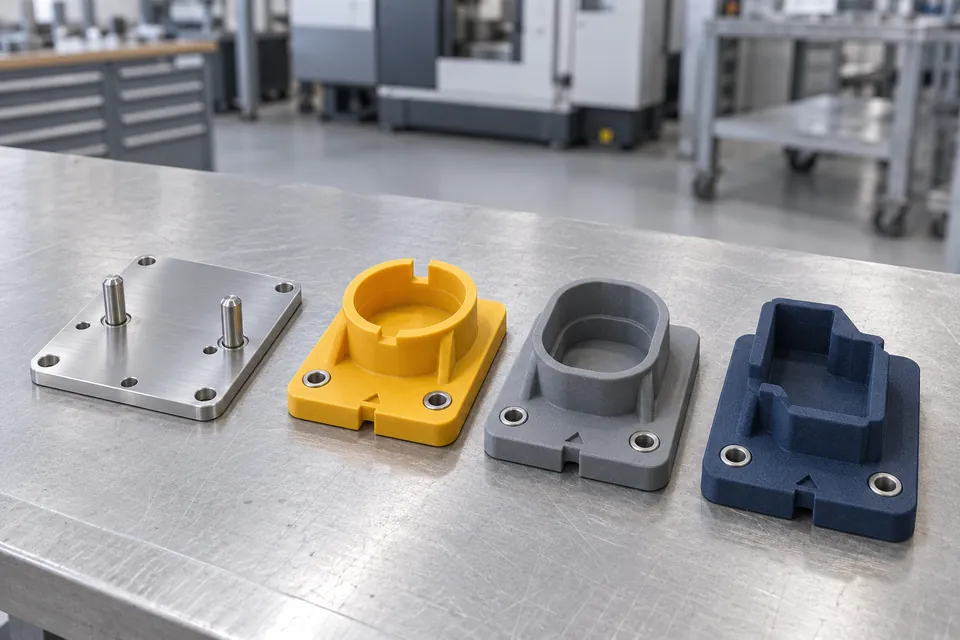
Hybrid: print what needs a contour – keep the rest simple
Large fixtures are rarely printed in their entirety. A base structure made of aluminium profiles and a laser-cut base plate is usually more economical; only the locating fixture that touches the workpiece is made additively.
- Datum in metal: index pins, bushings and stops as purchased parts – the tolerance lies in the steel, not in the printed part.
- Swap on product changeover: only the printed locating fixture is made anew; frame and clamps remain.
- Size without limit: the frame can be larger than any build envelope (SAF, for example, 315 × 208 × 293 mm).
Typical strategies
| Production aid | First version | If needed in volume or duration |
|---|---|---|
| Locating fixture, inspection gauge, drill template | Additive, datums via purchased parts | Stays additive; for large sizes hybrid with profiles |
| Gripper fingers | Additive, variants from one file | Soft pads as elastomer or vacuum-cast parts |
| Transport plug, protective cap | Additive (TPU) for testing | Elastomer or injection moulding from about 1,000 pieces |
| Moulded insert for workpiece carrier | Additive or vacuum casting | Mould foaming or vacuum casting in small series |
| Clips and holders in volume | Additive, SAF up to a few hundred | Injection moulding with additive tooling |
The material follows the application
| Requirement | Obvious direction | To be clarified |
|---|---|---|
| Lightweight, tough, gentle on the workpiece | Polyamide (PA12, PA11), additive | Forces, lever arms, moisture |
| Soft, non-slip, wear-resistant | Injection-moulded or pressed elastomer; PU by vacuum casting | Hardness, abrasion, media |
| Damping and cushioning | PU foam (mould foaming) | Density, recovery behaviour |
| Rigid and dimensionally stable over a long time | Filled plastics; metal for datums | Creep under load, temperature |
| High load, temperature, wear | Metal: aluminium (AlSi10Mg), stainless steel (316L), titanium (Ti6Al4V) | Rework, weight, cost |
| Food, pharma and ESD requirements | Materials with suitable certification | Applies per material and process – clarify in writing beforehand |
Rubber-like printing materials do not reach the properties of true elastomers; FIT states that elastomer parts have “significantly better properties than additively manufactured, rubber-like materials” (fit.technology, Conventional processes).